Showing posts with label Books. Show all posts

Tuesday, February 19, 2008

November, December, January Book Reviews

Somewhere between work, ski season, and the holiday crafting frenzy, I've slipped 3 months behind. Arg! I haven't done tons of reading, but the ones I did make it through were substantial. Here goes...

1. Y The Last Man, V. 9, Brian K. Vaughan et al., Rating: 4.5
Finally, a major plot reveal! After nearly a year of globe trotting, we learn the source of the epidemic. It's a good installment.
2 & 3. Fables, V.8 & 9, Bill Willingham et al., Rating: 4.5
As always, excellent. Beautiful artwork, compelling story.
4. How Doctors Think, Jerome Groopman, Rating: 3.9
This was a nice counterpoint to October's medical read, Better. Both take on the subject of how doctors interact with patients, and how they can learn to give better care. While I think Gawande is a stronger writer, this book is well-written and insightful. If you care about the subject, read both.
5. Ride with Me, Mariah Montana, Ivan Doig, Rating: 2.9
The final installment of Doig's Montana trilogy, Ride with Me is a pale shadow of the previous two books. Stick with English Creek.
6. Intuition, Allegra Goodman, Rating: 1.9
This book was doomed from the beginning. It's a legal thriller, of sorts, packed with sexual harassment, workplace drama, mistaken love affairs, and emotional drama. Goodman clearly understands the office politics of the environment she's describing. It's just that the environment is so boring. Seriously - who wants to read about the day-to-day squabbles of 15 medical researchers? Working with mice? Nice try, but it doesn't work.
7. California History, Harr Wagner and Mark Keppel, Rating: 4.0
I found this book - published in 1927 - at the Napa Library book sale about a year ago. The package itself beautiful - embossed red cloth with blue line drawings, thin glossy paper, dozens of photographs. It looks great on a shelf, with my collection of other orange books (the only color I have a section for - they just look so nice together). The book itself is mixed. It's often charming and sweet, often wrong, and, at times, horribly racist. Native Americans don't fair well at all - there are 2 chapters devoted to their "laziness". I wouldn't give this book to anyone to read, but as a snapshot of the time period, it's great.
8. Severance, Robert Olen Butler, Rating: 2.0
Butler gets a big gold star for a clever idea. This book is a series of essays cataloging the final thoughts of people between beheading and death - roughly two pages per person. The people are interesting (Marie Antoinette, for example), the thoughts intriguing. However. He makes no distinction between people who know that they're going to die and those who don't. I think it's a huge line that must be drawn, and it's a critical error.
9. The Good Earth, Pearl S. Buck, Rating: 4.8
I really liked this book. It's moving, interesting, full of complex characters, and brings to life a world that's extremely foreign.
10. The Executioner's Song, Norman Mailer, Rating: 3.7
I understand the hype around this book - the research is voluminous, the writing considered and detailed, the character exploration nearly bottomless. Unfortunately for the average reader, it's over 1000 pages long. And you know the conclusion from page 1. It...just...drags....on.
11. The Abstinence Teacher, Tom Perrota, Rating: 3.0
Perrota's Election was genius - the biting humor of the movie owes everything to Perrota's writing. Little Children was inspired, too. This book, unfortunately, is average. It's fine - but nothing more. The anger and wittiness of his previous books is missing. From another writer, this is a decent effort, but from Perrota it's a major disappointment.

Sunday, November 11, 2007

October 2006 Book Reviews

1. Better, Atul Gawande, Rating: 4.3
Like Gawande's previous book Complications, Better is a thoughtful, entertaining, and informative work. Without being pedantic or overly technical, he touches on major issues influencing modern modern medicine and the world at large. I like his mix of personal anecdotes and actual research. This is definitely a book that is worth reading, whether or not you're in medicine.
2. English Creek, Ivan Doig, Rating: 3.7
3. Dancing at the Rascal Fair, Ivan Doig, Rating: 4.2
English Creek is quite good - good enough that I went right out and got the second book in the trilogy. The action in Dancing actually takes place before that of its predecessor, and I enjoyed it much more. It was oddly satisfying to read about people when you already know much of their outcome. The second book also explains the history and populating of the "two medicine country", which adds a lot of depth to the series (in many ways, the land is the subject of the book, more so than the people). I just picked up the third book - full report to come on that next month.
4. Son of a Witch, Gregory Maguire, Rating: 2.2
The long-awaited sequel to Wicked is, like the rest of Maguire's books, a major disappointment. Wicked was clever and mischievous and very funny; this book is scattered, random, and hard to follow. It's also oddly homo-erotic in ways that are just plain odd.
5. The Empanada Brotherhood, John Nichols, Rating: 3.9
While I wasn't carried away by this book, I admire the craft of it. It feels very much like a Hemingway novel, with similar stripped-down language and dialogue-heavy chapters. The Kirkus review states, "The human energy swirling around the empanada stand is full of sound and fury but signifies very little." I think that might actually be the point.
6. The Gravedigger's Daughter, Joyce Carol Oates, Rating: 4.2
I've always considered Oates an "Oprah" writer, melodramatic and girly, slightly lowbrow, without ever reading any of her works. I totally take it back - The Gravedigger's Daughter is strange, dense, filled with fascinating characters, and beautifully written. Considering how prolific she is (a book a year on average), I have nothing but awe for the talent of this writer. I'll definitely read more of her books.

Monday, October 08, 2007

September 2007 Book Reviews

Better late than never? I had a birthday party this past weekend, and have been busy getting ready for the last week. I did, however, manage to read two pre-1960 books in September. And more non-fiction than fiction. I'm breaking my normal habits!

1. A Member of the Wedding, Carson McCullers, Rating: 4.0
This was an NPR recommendation that I picked up on a whim. McCullers has a really unique voice. This particular story is that of a pre-teen girl, wanting to be more (more interesting, have more friends, have a better life, anything), and creating her own reality in which the impossible could happen. I has really impressed with both the realism of the character, and McCullers' gift for making you understand exactly what the character is going through. It's like being eleven again.
2. Where I Was From, Joan Didion, Rating: 4.0
My new friend Chris sent me this book after I took him to Point Reyes for the day. I think I did a pretty good job of convincing him that California is a really nice place to live. He recommended (and sent me) this book - an homage and narrative of the state by one of its most revered writers. It's really fascinating. It's a fairly slim book, but it took me two weeks to get through. That's a big compliment - I kept slowing down and rereading passages, unwilling to miss anything.
3. Exodus, Leon Uris, Rating: 3.2
This book is fascinating. It has all the elements of a 1970 bestseller: implied sex, wartime heroes, abused and needy children, despots and criminals in powerful positions, and a dramatic, arid landscape that must be conquered. It's really a page-turner. It also ends on an up note - the chosen people triumph! The irony is that the book will be 50 years old next year, and the same struggle violently continues.
4. Four Seasons in Rome, Anthony Doerr, Rating: 2.3
This is another NPR book, but unfortunately one that makes for a better interview than read. It's about an American couple living for a year in Rome with 6-month old twins. That's about all there is to it. It's fairly sweet and charming, but never really rises about the level of an edited journal.
5. Every Visible Thing, Lisa Carey, Rating: 3.7
Like my first book this month, Every Visible Thing is told from the point of a pre-teen (in this case, two of them). The subject matter is much deeper - a missing sibling - but it has a similar realism and point of view that makes the writing succeed. This isn't a great book, but it's a good one.

Monday, September 03, 2007

August 2007 Book Reviews

I got off to a slow start in August, and then cruised through four books in the last week. A lot of beach time helps.

1. Harry Potter and the Deathly Hallows, J.K. Rowling, Rating: 4.3
She didn't let us down - while it's not better than the rest of the series, it's absolutely a worthy successor. I only slowly got into the plot, but by the end I found the book impossible to put down. I cried at the conclusion. (Happy tears or sad tears? You'll have to read it to find out.)
2. The Road to Samarcand, Patrick O'Brian, Rating: 4.4
This is a perfect summer read - fairly short, action-packed scenes, lots of emotional depth, and fascinating characters. This is my first Patrick O'Brian novel, and I plan to pick up a few more. The book was published in England in 1954, but is only now being released in the U.S.
3. The Yiddish Policemen's Union, Michael Chabon, Rating: 2.9
It wouldn't be fair, I suppose, if every book was great. I loved Chabon's earlier novel, The Amazing Adventures of Kavalier and Clay, but haven't liked any of his other works, this most recent book included. Which isn't to say it isn't well written. I think it probably is quite good, but it's not for me. Chabon has a gift for genre fiction. It's up to you, the reader, to like the genre he has chosen to write in. Noir mysteries are not my cup of tea.
4. The Post-Birthday World, Lionel Shriver, Rating: 4.0
The plot of this story hinges on a single decision - whether or not the narrator chooses to kiss a man. Chapter by alternating chapter, the book explores what would have happened if she did (or didn't). It's an interesting concept, a choose-your-own-adventure novel for adults, and it's beautifully executed. I love that the "right" decision is ambiguous throughout much of the novel. It's not really an easy book, but it's honest and intriguing.
5. Jack of Fables, Bill Willingham et al, Rating: 4.0
The Fables universe recently spun off this new series, featuring Jack (and the beanstock, the candlestick, Jack Frost, etc. - all the same guy). It's great. There's energy in the storytelling that has been lacking in the main series for awhile. Perhaps the creators just needed the freedom to create a new world.
6. Sin in the Second City, Karen Abbott, Rating: 0.5
I've seen perhaps a dozen reviews for this book in the past few weeks, and am convinced that not a single reviewer actually read the book. The subject matter has potential (very high end prostitution in Chicago around the turn of the twentieth century), but the execution is awful. Terrible. Seriously-wasting-your-time bad. Skip it.
7. On Chesil Beach, Ian McEwan, Rating: 3.8
This book is very different. The entire plot revolves around a single, emotionally-fraught night (a wedding night), as two newlyweds struggle to express their fears and feelings, without having the experience or emotional vocabulary to do so. The reading experience feels slightly inappropriate - the moment seems so private - and yet it's hard to pull away from. I do recommend it, but don't expect it to be a light read.

Wednesday, August 08, 2007

July 2007 Books

Let's start with first things first: yes, I've finished Harry Potter. But I'm holding that review back a month for all of you that are still reading.

1. All Creatures Great and Small, James Herriot, Rating: 4.4
I read this as a teenager - it (and the rest of the series) is one of my mother's favorite books. Herriot was a vet in rural England beginning in the 1930s and continuing well into the 1970s. His stories focus on the early years, getting to know the countryside, his clients (4-legged and otherwise), setting up a practice, and starting a family. He's the archetypal "glass half full" man - every moment, if sometimes a bit trying, is still a joy. I really enjoyed this reread (probably my third or fourth time) simply for his wonderful attitude.
2. The United States of Arugula, David Kamp, Rating: 4.0
Great books on food are few and far between, but this is absolutely at the top of the class. The text follows the last 60 years of food in America, but it's not your average non-fiction work. Kamp has a gift for writing about facts in an incredibly dishy, gossipy way. It feels like you're really getting the inside scoop. He's quite persuasive - I actually went out and bought grass-fed steaks while I was reading it.
3. Catherine the Great, Virginia Rounding, Rating: 3.5
This author is less adept. The book is interesting - Catherine the Great was a very intriguing woman - but occasionally lapses into slow cataloging of facts. I'd only recommend it if you really want to know a lot about her, or the start of the Hermitage Museum.
4. One of Ours, Willa Cather, Rating: 3.0
I'm making an effort to read fewer new releases. One of Ours is a Pulitzer Prize winner; unfortunately it's not Cather's best work. There's nothing really wrong with it - I enjoyed seeing WWII through the eyes of someone writing immediately following it - but it's slightly flat and slow moving.

Saturday, July 07, 2007

June 2007 Book Reviews

We're having a beautiful summer, the kind San Francisco is absolutely not known for. Warm evenings, long hot days, bright mornings. I've spent a lot of time reading in the yard and at my local swimming hole, Lake Temescal.

1. The Hypocrisy of Disco, Clane Howard, Rating: 4.0
This is an upcoming Fall release from Chronicle Books. I was pleasantly surprised by it - the author recounts a few years of her decidedly non-traditional upbringing in Northern California (think camping in abandoned fields, macrobiotic food, and a complete lack of knowledge of - or access to - basic hygiene). She very accurately captures the language and attitudes of her 13-year-old self. I hope this sells well enough to allow her publish the rest of her story.
2. Confessions of an Economic Hit Man, John Perkins, Rating: 1.0
I hated this book. Finishing it was painful. Perkins clearly has a point to make: if you miss it the first time, don't worry, he'll say it again. And again. And then 10 times more in the next chapter. Basically it goes like this: "What I and other economic hit men do is terrible. We're awful people. We fly to exotic lands first class and hang out with world leaders. Because of our jobs we exploit the people of third world countries. Did I mention that I spent time with world leaders? Let me tell you how cool it was the time I hung out with Fidel Castro." And repeat.
3. The Emperor of Ocean Park, Stephen L. Carter, Rating: 3.2
To enjoy this book it's necessary to forget that the story is a mystery. The writing and characters are quite good, the plot long-winded and at times hard to follow. Once I resigned myself to just being along for the ride, I liked it quite a bit.
4. We Are all Fine Here, Mary Guterson, Rating: 3.9
This is a bitterly funny, slim little book. It's short but packs a surprising amount of emotional impact. The story follows a woman who has a one-time fling with her high school flame, and finds herself pregnant, unsure if the father is her husband or old boyfriend. This isn't chic-lit; the narrator's emotional journey as she approaches the birth is smart, honest, and very real.
5. Fables: 1001 Nights of Snowfall, Bill Willingham, Rating: 3.0
This is a one-off in the Fables series, a self-contained side-plot. The art is stunning, the story itself uneven. If you're a huge Fables fan, check it out, otherwise stick to the main series.
6. Y The Last Man: V. 8, Vaughan & Guerra, Rating: 3.2
I can't tell if I'm just losing my interest in this series, or if the writing is declining. This is fine, slightly formulaic. The plot line is progressing too slowly for my taste - it's time for a major revelation or a new central character.
7. The Bible Unearthed, Israel Finkelstein and Neil Asher Silberman, Rating: 3.0
The subject matter of this book is fascinating: modern archaeological finds, and how they support / don't support stories in the Bible. The treatment is too scholarly - in the hands of a different set of writers, I really think this could be a real eye-opener. Instead, it's dense and extremely hard to digest. It also really should have included pictures to bring the finds to life.
8. In My Father's Court, Isaac Bashevis Singer, Rating: 4.2
Singer has collected his childhood memories in this charming collection. He grew up in an ultra-orthodox home in pre-WWII Warsaw, one of the youngest children of two highly intelligent, devout people. It's a very intimate account, and also quite moving. The upcoming Holocaust is a constant shadow over the characters, but it doesn't interfere with the joy that comes across in many episodes. (As a random aside, Singer also wrote the story that became the movie "Yentl", and won the Nobel Prize in 1978.)
9. Prisoner of Tehran, Marina Nemat, Rating: 3.8
Nemat was imprisoned as a teenager for her political views, one of tens of thousand such prisoners. After two years (and forced marriage to one of her captors), she was freed and eventually able to move to Canada. She buried her memories for nearly twenty years. Although not a natural writer, Nemat has a fascinating story to tell, and very successfully captures the conflicting emotions she's had about her past.

Saturday, June 02, 2007

May 2007 Book Reviews

Several of the books on my library queue showed up this month, all at the same time. I've been reading quite a bit, trying to get through them.

1. Talking with My Mouth Full, Bonny Wolf, Rating: 3.7
Entertainment Weekly ran an article last fall about the best in food writing and food memoirs. Some were certainly not the best (I found Madhur Jaffrey's Climbing the Mango Trees unreadable), but several have been worthwhile. This particular book is perfectly fine - it's fun to read, has funny anecdotes and personal details, and passes the time well. It's a good summer beach book for people that like food.
2. Low Life, Luc Sante, Rating: 2.3
Low Life is a history of New York City's underbelly - the gambling, corrupt cops, tenements, prostitutes, etc. While a wonderful premise for a book, the execution rarely rises above the level of a catalog. Each chapter is basically a list (Smelly Joe did X on Houston, rival gang leader did Y on Broadway), making for horribly tedious reading. The one chapter I did like was about the draft riots. If you're interested in New York history, I'd recommend the PBS documentary ("New York") instead.
3. The Castle in the Forest, Norman Mailer, Rating: 4.2
Norman Mailer is a remarkable writer - advanced age certainly isn't slowing him down. This novel (about Adolf Hitler) is bizarre, at times quite dirty, and impossible to put down. It bears more than a passing resemblance to some of Neil Gaiman's books (the narrator is a devil who interacts with the Hitler family).
4. Ask Again Later, Jill Davis, Rating: 3.0
I wrote "fairly standard chic lit" in my book journal when I finished this 10 days ago. Given that I've already forgotten most of the plot, I think that it's an especially appropriate summary.
5. Medicus, Ruth Downie, Rating: 3.7
Ruth Downie was interviewed on NPR recently. She has a lovely British accent and sounds like a kind, sensitive person. She has raised several children and only began writing seriously in late middle age (this is her first novel). The interviewer made a big deal of how readable the novel is, and also how it accurately represents what it was like to be a doctor in the roman era. The first claim is certainly accurate; the second is probably a stretch (very little doctoring actually happens). It's a pleasant book.
6. Chinese Lessons, John Pomfret, Rating: 4.0
John Pomfret has spent most of his adult life in or around China, starting with a year during college in the early 1980s. This book chronicles the rise of modern China through the stories of his classmates. It's fascinating - and deeply disturbing. I'd definitely recommend reading this.

Saturday, May 19, 2007

Alibris

I just started writing email newsletters for Alibris (thanks Jason for the recommendation!) - the first should be sent out next week. If you like books, I'd recommend signing up. Being a site specializing in used and new books, they're not locked in to recommending new releases. I've had a lot of fun digging through my book archives to find some great classics.

Saturday, May 12, 2007

April 2007 Book Reviews

Sorry for such a long delay on this post! I actually wrote it last week, and then blogger crashed and the post was lost. Ugh. It's taken a while to find the motivation to write it again. It was an great month for books, though.

1. One Hundred Years of Solitude, Gabriel Garcia Marquez, Rating: 4.7
As best as I can remember, I read this for the first time in 2001 or 2002. I liked it well enough, but just couldn't quite see why people were so enthusiastic about it. Adam read it on our Colombia trip, and I decided to give it another try when he finished. Wow - it's incredible! I was completely absorbed and couldn't put it down. I think it must have been too young, or found it too different, or... something. Who knows. If you haven't read it recently, I definitely recommend giving it another try.
2. The Last Report on the Miracles at Little No Horse, Louise Erdrich, Rating 4.3
This is the third book I've read by Erdrich in the past year (read about the other two here and here), largely because I continue to be incredibly impressed by her writing. While her novels are mostly set in the same geographic area, her plots and characters are wildly different. This story, the first of her books to reach a wide audience, includes a cross-dressing priest, fake saint, a shoot-out, and 100 years of history. What's not to love?
3. Alternatives to Sex, Stephen McCauley, Rating: 1.3
I think I can credit Entertainment Weekly for this recommendation - clearly the reviewer read the jacket but never cracked the book open. What is the Alternative to Sex? Real estate. There are a number of genuinely witty lines throughout, loosely held together by some truly god-awful prose. Seriously, reading this book is like spending an entire day at the dentist. Just say no.
4. The Thin Place, Kathryn Davis, Rating: 3.2
Davis is a gifted writer, able to very quickly create highly atmospheric, slightly surreal worlds. This collection of somewhat disjointed vignettes is lovely and involving, but doesn't quite come together. This book wasn't for me, but I'll certainly try to read one of her novels again.
5. Angle of Repose, Wallace Stegner, Rating: 4.9
Yes, 4.9! This book is making the top 10. I LOVED it. Couldn't put it down. Cried a few times. Got out a map so I could visualize the places that were described. The introduction claims that it was voted "the best book about the west" in the San Francisco Chronicle, and I have to say I agree. It's largely set in the 1870s-1890s in various places west of the Mississippi, is largely based on the life of a real person, and it won the Pulitzer. You'll have to read it to find out more.

Saturday, April 07, 2007

March 2007 Book Reviews

How do you choose what to read while you're on vacation? It's frequently a complicated decision for me. 1) It must be lightweight and smallish - we don't check luggage unless we absolutely have to. 2) It needs a strong narrative and should be fairly "easy" - I don't want to work while I'm on vacation, and it should be capable of keeping me entertained on a long flight. 3) It needs to be mine, and I have to feel comfortable with it getting ruined by getting splashed at the ocean, covered in sand, etc. 4) It needs to be long. Or I need to bring several books.

On to the books:
1. Lost Nation, Jeffrey Lent, Rating: 4.5
A western in the Cormac McCarthy vein - complex, bloody, cruel and unforgiving. Lent's characters are beautifully realized and you get to know them intimately, despite the fact that their lives are far removed from anything we'd ever experience today.
2. There is No Me Without You: One Woman's Odyssey to Rescue Africa's Children, Melissa Fay Greene, Rating: 3.5
Greene has written the story of AIDS in Ethiopia, intertwined with the story of a single woman who (somewhat accidentally) became a major player in international adoption and continues to care for and house dozens of AIDS orphans. The book is well worth reading simply for its smart and thorough overview of the AIDS crisis in general and the plight of Ethopians specifically. The story of this single woman at times feels forced and artificial - an attempt to give a "human center" to the narrative - but it's still an admirable and educational book.
3. The Name of the Rose, Umberto Eco, Rating: 3.2
This is the book I chose for my recent vacation. It met criteria 1, 2, and 4, and seemed promising for #3 - the jacket made it seem like a high-brow version of The Da Vinci Code. Which actually is fairly accurate - really high-brow. Don't get me wrong, it's an amazing work. Clearly Eco is a smart guy: to quote the anonymous writers on wikipedia, "Eco is particularly good at translating medieval religious controversies and heresies into modern political and economic terms so that the reader can appreciate their substance without being a theologian." It's a very dense, slow-going, deeply educational work - not very entertaining at all. Sure, read it, but don't pack it.
4. Sophie's Choice, William Styron, Rating: 4.3
Our hotel in Colombia had a wall of English-language titles, with an odd mix of political theory, romance, mystery, and 70s-80s bestsellers. I traded in my copy of The Name of the Rose for this, which again seemed to meet the criteria above. And - it did! Wonderfully! I actually finished it the next day, 12 hours into a 14 hour travel day. I'm sure someone at some point told you what the book is about; if not, well, as the title implies there's a main character named Sophie and at some point in the story she has to make a choice. I was shocked to find the bulk of the novel is a tawdry, sexy, violent love triangle in late-1940s Brooklyn. It's fascinating and humorous and very fun. And yes, it does have a powerful climax.

Sunday, March 04, 2007

February 2007 Book Reviews

I've officially overdone it - no more historical fiction or royal biographies for me. At least this month.

1. Forgetfulness, Ward Just, Rating: 4.4
I reserved this at the library after reading this in the Washington Post:
"Ward Just's thrillers are so subtle that they risk sounding dull, as though he's engaged in a battle against excess and bombast. The movement in his stories is slight, but the forces at work are tremendous. That muted power has never been more unsettling than in his new novel, a response to Sept. 11 that stretches the boundaries of an already voluminous genre."
Intriguing, right? It is an upsetting novel - it's about a man coming to terms with the murder of his wife - but it's beautifully crafted. Despite the inherant sadness of the work, it's a pleasure to read a book so skillfully written.
2. The Boleyn Inheritance, Philippa Gregory, Rating: 3.0
This book pales in comparison to the previous title. It's fine, nothing more. I found the author's postscript the most interesting thing about it. Gregory describes a character, and the qualities she worked hard to build in to her portrayal. I didn't get it at all. Did I just miss the obvious, or did the author mention the subject because she realized she hadn't succeeded?
3. Marie Antoinette: A Journey, Antonia Fraser, Rating: 4.0
It's a shame I didn't read this at the start of my French royalty phase. It's certainly the best I've found on the subject - well researched and scholarly, highly readable, deeply informative.
4. It's All Over But the Shoutin', Rick Bragg, Rating: 2.7
Billed as a memoir about (and for) his mother, Bragg writes about his upbringing in deep poverty and eventual success (he's a Pulitzer-winning journalist). I have two complaints about it. 1) Bragg continually says "You just can't understand why she [his mother] didn't stand up against her abusive husband, get a better job, try to get out of poverty, etc.]." And he's right - I don't understand. I don't have any insight into the woman at all after reading this book. 2) It's really a book about him, not her. You can almost see some editor leaning over his shoulder and saying "You haven't mentioned your mother for 10 pages. How can we work her in to this paragraph?" The end result is tiresome and forced.
5. King Dork, Frank Portman, Rating: 3.7
I liked this quite a bit. It's longer than it needs to be, and at times seems to lose sight of the plot, but it's really clever and occasionally hilarious. I can not for the life of me figure out why it's a YA novel. Is it because it's about a teenager? It's quite sophisticated and clearly well-suited to an adult audience. Maybe they thought it would get more press in the YA category? As an aside, can you see that this cover is supposed to reference Catcher in the Rye? It's pretty obvious to me when I see it on screen, but I didn't notice it on the physical version at all. It's odd - one of those times when a design just doesn't work in print form.

Saturday, February 03, 2007

January 2007 Reviews

My library queue - which has been stalled for what seems like months - seems to be moving again. I was able to get through a few titles that have been on my "to-do" list for quite some time. There's not a loser in this bunch, either - all were great reads.

1. The Painted Drum, Louise Erdrich, Rating: 4.3
Erdrich, an author I read for the first time back in October, really has an exceptional talent. The plot is layered and complex, full of well-realized characters and interesting twists. My only quibble is the cover, which depicts a woman obviously far too young and inappropriately dressed to be the narrator, or any other character. But just ignore that, and read the book.
2. Love and Louis XIV, Antonia Fraser, Rating: 4.0
Give me another six months, and I'll be an expert on European royalty. This is one of the best accounts out there. It chronicles the life of Louise XIV, and the women that shaped his life. I found it fascinating, never tedious, and extremely well-researched.
3. Kafka on the Shore, Haruki Murakami, Rating: 4.2
I can describe all of Murakami's books in the same way - odd and fascinating - but that doesn't mean each book is at all alike. Each is odd in its own, very special way. This is no exception.
4. The Perfectionist, Rudolph Chelminski, Rating: 4.1
I realized recently that I'm swiftly heading towards the day when I'll read more non-fiction than fiction (this assumes that we consider memoirs non-fiction). It's a few years off, but coming. The Perfectionist is a prime example of what's pulling me over - carefully researched, packed with interesting information, beautifully written, and "worthwhile" - you feel like you learned something by reading it. It's the story of Bernard Loiseau, 3 star chef, and the Michelin rating system. If you like food and France, you'll enjoy this book.
5. Between Meals, A.J. Liebling, Rating: 3.8
This was a lovely follow-up to The Perfectionist. Liebling, a deceased New Yorker writer, published this collection of articles near the end of his life. The subject: eating in France. Most of the narrative concerns the late 1920s, when he was a student in Paris. Liebling considered himself a "feeder" - not a gourmet - and describes the truly massive meals he ate on a regular basis. Here's a funny little tidbit about the author: He worked briefly in the sports department of the New York Times, and was fired for listing the name "Ignoto" (Italian for "unknown") as the referee in results of games.

Sunday, January 14, 2007

December 2006 Book Reviews

Better late than never?

1. Queen of Fashion, Caroline Weber, Rating: 2.5
I made the mistake of thinking this would be a "fun" read - Marie Antoinette, seen through a fashion lens. It's a serious, scholarly, extremely well researched and documented look at her life (it includes 120 pages of footnotes and citations). The author's credentials are serious and I admire her effort; the actual work is really dry. And the biggest problem? She describes clothing very poorly. I finished the book and still don't have a clear idea of what the clothes actually looked like.
2. The Scroll of Seduction, Gioconda Belli, Rating: 3.0
Another look at European royalty, this time Juana the Mad of Spain. There's little published (in English, at least) about this interesting woman, supposedly driven mad by her husband's wandering eye. My biggest quibble with this account are the utterly unbelievable liberties the author takes to flush out the story. Rather than creating a 3 dimensional character, Belli creates a caricature.
3. Middlemarch, George Eliot, Rating: 3.9
Middlemarch is funny and sharp, even biting at times. There's clearly an agenda from the get-go, and I found it interesting how she focused people to display that how they really are, and how they are perceived by others, are so often different. The book is long - it was a struggle at times to finish - but worth the effort.
4. The Texicans, Nina Vida, Rating: 4.1
After a slightly bumpy start, this short, compelling novel swings into high gear, detailing the lives of numerous characters with intersecting lives. It's fun.

Saturday, December 02, 2006

November 2006 Book Reviews


1. A Game of Thrones, George R.R. Martin, Rating: 4.3
Hayden recommended this book highly - he said that he was finding himself staying up for hours reading every night, unwilling to put it down. I should say that fantasy is not one of my usual genres, and yet I too found it fascinating. Not so much that I stayed up all night, but I do have the next one here in the house, and can't wait to crack it open. EPIC scope (think Lord of the Rings, with more characters), fully imagined settings, great heroes and villains (plus lots of people that could be either - only time will tell). It's really fun.
2. Special Topics in Calamity Physics, Marisha Pessl, Rating: 1.9
I absolutely loved the first 100 pages of this book. Pessl has a very clever way with words, and uses bibliographical references to describe people and events. It's very effective. The plot, and its strong parallels to Lolita, works well well the characters are on the road. When they stop, and the author is left to invent her own plot twists, everything falls apart. The Washington Post says it well: "But hunkering down for 514 pages of frantic literary exhibitionism turns into a weary business for the reader, who after much patient effort deserves to feel something stronger than appreciation for a lot of clever name-dropping and a rush of metaphors."
3. Altered Carbon, Richard K. Morgan, Rating: 4.2
Another book outside my normal genres - this time, science fiction. No aliens (thank goodness), but it is set in a future with habitation on multiple planets. Much to my surprise, I really, really liked this. It's set in San Francisco (a few hundred years in the future), has a great lead and several suitably villanous villains, and is packed with absolutely fascinating ideas about future technology. I can't say much without giving away the plot, but if you can handle some fairly aggressive, graphic violence, I'd recommend checking this out.
4. One Year Off: Leaving It All Behind for a Round-the-World Journey with Our Children, David Elliot Cohen, Rating: 2.9
There's not a lot I can say about this book that isn't covered in the subtitle. I saw this at the library and thought, "huh. That must have been interesting and difficult." And it was - for them. For us, the readers, it's kind of dull. Their kids are young - 3, 7, and 8 - and the trip was planned to make them happy. I love the idea of traveling for a year, but not just to places that interest a first grader.
5. The Last of Her Kind, Sigrid Nunez, Rating: 4.0
First of all, what a beautiful cover. I think it's just great, and perfect for the contents of the book. This story is told through the eyes of one woman, who's relating her own life, and those of the three women (her sister, her best friend, and her mother) who shaped her. With three younger women are all shaped by the civil rights movement and the 60s and 70s in general, but in very different ways. It's really fascinating.

Saturday, November 04, 2006

October 2006 Book Reviews

1. Getting Stoned with Savages, J. Maarten Troost, Rating: 2.9
Troost's greatest strengths are clearly 1) his willingness to seek out and live on far-flung islands, and 2) the ability to generate great book titles. His first travel memoir, The Sex Lives of Cannibals, came out a few years ago; this book was published in June. This book is even more of a disapointment than the first.
2. Lolita, Vladimir Nabokov, Rating: 4.2
Finally I've read this - it's been on my to-do list for years. I really liked it, and was completely surprised by the story. The prose is every bit as beautiful as you've heard, but the story was dark and meadering and manipulative. I expected "sexy," but there really isn't much about it that fits that description. I was surprised to learn that it was written originally in English - intentionally so, as Nabokov describes this as his "american novel."
3. Crawling, Elisha Cooper, Rating: 4.0
I've known Eli for years now - he published several books with Chronicle when I first started working there. He writes children's books primarily, and this is his first primarily prose book for adults. It's about his first year as a parent, and is also a tribute to his life in Berkeley (he now lives in Chicago). I thought it was funny and surprisingly candid.
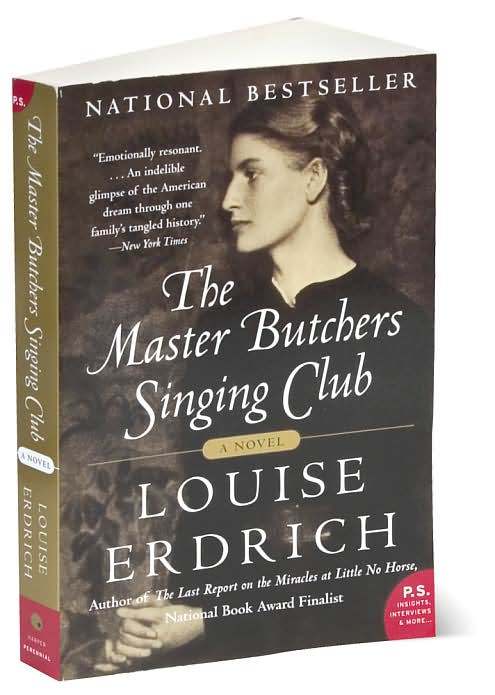
4. The Master Butchers Singing Club, Louise Erdrich, Rating: 4.6
Thanks to my friend Elese, who gave me this book for my birthday. Based on the cover and the title, I would have never picked it up. It's full of interesting characters and has a sweeping, emotionally packed storyline. I don't want to give too much away about the story, except to say that the title isn't even accurate - there's just one butcher. It is correct to say that he sings, though.
5. The Road, Cormac McCarthy, Rating: 3.2
This rating is probably too low, but I feel uncomfortable recommending this novel to most people. It's DARK. Intentionally so (the main theme is the end of the world), but (having loved McCarthy's Blood Meridian) I was surprised by how tough this novel is. I read it almost entirely on the commuter train, because it was too creepy to read at home alone. That said, this is an incredibly well-done story and worth reading - if you can stomach it.

Monday, October 02, 2006

September 2006 Book Reviews

September was a truly exhausting month. It involved a cross-country trip (or at least mid-country), a birthday weekend getaway, 10+ hours of freelance work, and one complete house move, which was just completed last night. So very little reading. Here's what I managed to read on the commuter train:

1. Gramercy Park, Carole Klein, Rating: 3.9
I remember exactly when I got this book - while in summer school at NYU in 1999. It's been on my shelf ever since, waiting to be read. I had a vague idea that it was some sort of late nineteenth century work of american lit. That was completely wrong - it's actually a non-fiction history of the neighborhood in New York City. It's surprisingly compelling. The author essentially strings together a series of mini-biographies of famous New Yorkers who were in some way affiliated with the neighborhood. Definitely not for everyone, but I really enjoyed it.
2. Veronica, Mary Gaitskill, Rating: 3.4
I seem to see this book everywhere these days. It follows one woman along a trail of bad decisions through the '80s and '90s. AIDS and other related diseases feature prominently. The story is unique and thought-provoking. I'm not recommending it strongly, but it's definitely better than most contemporary fiction.
3. Cellophane, Maria Arana, Rating: 4.3
I am strongly recommending this one -- if you're a fan of magical realism. The story is completely fantastic, whimsical and sexy, at times hilarious. It's escapism at its best. I would strongly recommend this as a vacation read.
4. Cry, The Beloved Country, Alan Paton, Rating: 3.5
What a downer this book is. Purposefully so, clearly, and there's no denying it's extremely effective, but it's really sad.
As a side note, the intro is really interesting - Paton finished his manuscript in San Francisco and loaned it to a couple he had met on the train. They went to extraordinary lengths to get the book published - had found the publisher, had the manuscript typed (the whole thing in a matter of days - they worked around the clock), arranged all of Paton's meetings. All for a virtual stranger.
5. Mother Tongue, Bill Bryson, Rating: 4.1
This book has been on my list forever. My aunt has a copy on her shelf and I read a chapter or so whenever I'm over at her house. She recently took a nice long trip to Italy, which gave me enough time to finish it. While wikipedia takes issue with its level of accuracy, it's thought-provoking, raises innumerable interesting points, is full of conversation-starters, and it's often hilarious. Can we ask for much more from a book? The subject: the English language.
6. Pledged, Alexandra Robbins, Rating: 2.8
This book saved me on the never-ending flights to and from Chicago. The secret life of sororities - doesn't that say it all? Actually, it didn't really. While the book is definitely interesting, there are no secrets. No real opinions. No real facts, when you get right down to it. Just one writer with a good idea, and sloppy research techniques. There's definitely room for a more definitive book on the subject. This isn't to say that it's not entertaining - it is - but it leaves you wanting a lot more.

Sunday, September 03, 2006

August 2006 Book Reviews

I often find it difficult to give up on a book - I keep hoping it will get better. Recently I've set a 100 page limit; I allow myself to stop reading if I'm not enjoying the material by then. August was full of books I was unable to finish. Here's what I did get through:

1. March, Geraldine Brooks, Rating: 3.7
Smart and interesting, as a Pulitzer Prize-winning novel should be. My main quibble is that I didn't like the character of Mr. March at all - I found him rather repulsive. That's just me, though, others might really enjoy him. Brooks has an informative, succinct endnote of what's fact and what's fiction in her work that I found very interesting.
2. Comfort Me with Apples, Ruth Reichl, Rating: 4.2
Reichl is certainly one of my favorite food writers, and I find the candor with which she writes about her life fascinating. This book goes into rather explicit detail about the affairs she had in the 1980s. It's really fun in a voyeristic way, but her total lack of concern about how her husband would feel just comes off as odd. She doesn't seem cold otherwise; I suspect she's not being totally honest about how she really felt at the time.
3. Blessings, Anna Quindlen, Rating: 3.5
I think this is the first book I've read by Quindlen - it was fairly forgetable but passed the time well.
4. Tender is the Night, F. Scott Fitzgerald, Rating: 4.3
Fascinating and compelling. It reads like two different novels (the point of view of the narrator changes midway through). The writing is beautiful, the plot bizarre at times. Well worth reading.
5. Middlesex, Jeffrey Eugenides, Rating: 4.7
I recently loaned this book to Adam, who devoured it. I think it was one of his favorite books ever. He was so enthusiastic about it that I was jealous, and found myself reading it whenever he left it at the house. It's really an incredible work, with a really odd plot that sucks you in immediately. I appreciated the quality of the writing more this time - he's snuck in some quite clever jokes and phrases.
6. A Moveable Feast, Ernest Hemingway, Rating: 4.1
While not on the level of his novels, this book is a lot of fun. It's all about Hemingway's early years in Paris, and the people he knew (all famous, of course). It's really gossipy - like reading US Weekly without the pictures.
7. Fables, Volume 7, Rating: 4.0
I've written about this series before. I'll just say that it's one of the best comic books out there and you're really missing out if you're not reading it.

Sunday, August 06, 2006

July 2006 Book Reviews

I would be hard to top last month's selection; I did however finish several of the books on my to-do list. Next month, less contemporary fiction, more classics.

1. Matters of Chance, Jeannette Haien, Rating: 4.6
Wonderful, timeless love story . Or really, a series of romances. I was really surprised to discover that this came out in 1997--it has the feel of a much older story. Character development is superb.
2. The Moon and Sixpence, W. Somerset Maugham, Rating: 3.2
A fictionalized account of Paul Gauguin's life (according to wikipedia, just how fictionalized isn't entirely known), this is an interesting, if not entirely engaging, character study. I liked it enough to read more of Maugham's books, but found the narrative tedious at times.
3. Eat, Pray, Love, Elizabeth Gilbert, Rating: 2.9
Interesting concept - a woman's life completely falls apart (divorce, depression, bad love affair) - and after wallowing for several years, she decides to spend a year traveling to three countries that specialize in the things that matter most to her. Pleasure is the first section (to experience this, she travels to Italy, a wise choice). Later destinations are India and Indonesia. Some of the writing is fun; a lot of it is boring and of the "why am I reading this?" variety. She's incredibly self-absorbed and self-serving - it should be a major tip-off that she sold the book rights before beginning her travels.
4. A Woman in Berlin, Anonymous, Rating: 4.0
Recently reissued in America after decades of out-of-print status, this is the supposed true diary of a civilian woman living in Berlin during the siege and fall of the city at the end of WWII. The writer claims to be a professional writer by trade, which perhaps explains the polished prose. She exhibits an amazing sense of humor in the face of truly awful events. This is a fascinating book and one well worth reading.
5. The All of It, Jeannette Haien, Rating: 3.0
Haien's first book, this novella lacks the epic scope and effectiveness of Matters of Chance. While it's fine, I surprised it ever found a publisher - it's much more suited to a literary journal.
6. The Last Gentleman Adventurer: Coming of Age in the Arctic, Edward Beauclerk Maurice, Rating: 4.2
Published just before his death, this is a snapshot of several of the years - beginning in 1930 - that Maurice spent in remote Canada working for the Hudson Bay Company. Left alone with the local population for the majority of the time, he writes of learning to speak the local language, dogsledding for days to bring food to a starving camp, hunting and caring for the entire camp during a flu outbreak, and much more. It's thoughtfully done, a careful portrait of an extremely unique experience.
7. Money: A Memoir, Liz Perle, Rating: 3.5
This book is exactly what it claims to be: a memoir. It's about her relationship to money, with a few supporting examples from other women. It's interesting because of Perle's candor, but I expected more - advice, pitfalls to avoid, something else. Ultimately, I guess that wasn't the point of the book.
8. The Kite Runner, Khaled Hosseini, Rating: 3.1
I listened to this as a book on tape, which really didn't do the book any favors. Read by the author, the audio form calls attention to how repetitive the narration is, and drives home the fact that there are still hours to go before reaching the incredibly predictable conclusion. A sensitive, light-handed ending is perhaps the book's one saving grace.
9. Labyrinth, Kate Mosse, Rating: 2.9
A throw-away summer read. Among its strongest attributes is the lovely attention to geographic details. The characters and plot receive less attention.

Friday, June 30, 2006

June 2006 Book Reviews

June has been an incredibly busy month. I managed to spread myself way too thin and haven't had time for anything. Except, of course, reading - I think I've actually read more than normal just to wind myself down from each hectic day. It's also been a truly banner month in terms of finding great books.

1. Y The Last Man, V. 6, Vaughan and Guerra, Rating: 2.8
What a disapointment! I love this series, but this installment is a real dud.
2. Y The Last Man, V. 7, Vaughan and Guerra, Rating: 4.3
A return to form! If you're not reading this series yet, what's wrong with you? It's truly magnificent.
3. Leave Me Alone, I'm Reading, Maureen Corrigan, Rating: 3.0
Corrigan is the book critic for NPR's Fresh Air. Even if you don't recognize the name, you've probably heard her voice before. I like her reviews--I frequently read books based on her recommendations--and I was excited to read about what it's like to be a professional book reviewer. Clearly it's a busy life: Corrigan is also a teacher at Georgetown (as she herself admits, books just don't usually pay the bills), and reviews for numerous other publications. This book is a (not-entirely successful) blend of literary criticism, book review, and personal memoir. I wanted more of everything--except, I suppose, the criticism. Corrigan devotes at least half of the book to a discussion of the merits of detective fiction, the loss of the "work" novel, and "female extreme-adventure tales" (a category that I don't quite buy). In fact, all of her literary passions, which the exception of 19th century women's fiction, I'm not interested in at all. The other half of the book (her life) is great. So...I'm not really recommending this, sadly.
4. Black Swan Green, David Mitchell, Rating: 3.2
Decent. While I didn't find the subject compelling (the inner lives of preteen boys in 1980s England), the writing is quite good.
5. Possible Side Effects, Augusten Burroughs, Rating: 4.2
Very funny. Burroughs has taken a page from Sedaris and is no longer trying to structure his true-life stories into novel form; they're just lumped together into a fairly cohesive collection. His life is bizarre to the point of being unbelievable, but it's fun to tag along and wonder how he's survived.
6. The Madonnas of Leningrad, Debra Dean, Rating: 3.8
I heard an interesting interview with Debra Dean on NPR recently. She's a former actress (which comes across in her very succinct pronunciation) and currently a full-time writer. This novel deals with the effects of Alzheimer's disease, intertwined with a history of the hermitage museum during the seige of leningrad in WWII. It's quite well done.
7. A Death in Belmont, Sebastian Junger, Rating: 4.3
Fascinating! Junger (of Perfect Storm fame) has thoroughly researched the Boston Strangler. It's very personal and bone-chilling--the Strangler actually worked as a contractor in his childhood home for a time.
8. My Life in France, Julia Child with Alex Prud'homme, Rating: 4.7
This is absolutely the best book I've read in quite some time. It details much of Julia Child's life, focusing on a 20+ year span in which she married, lived in numerous European cities, and learned to cook. You can hear her funny, odd voice in every sentence. Her enthusiasm is boundless, she clearly loves all food and finds most people fascinating, and she lived a really remarkable life. (Prud'homme is her grand-nephew; he helped her assemble this book before she died, relying on letters Child and her husband sent to the states during their years abroad.)
9. Tender at the Bone, Ruth Reichl, Rating: 3.9
Reichl's first memoir, this deals with her childhood and early 20s. It's not so much food writing as a discourse on the evolution of a chef (who just got pulled out of the kitchen at the right moment).
10. Fun Home, Alison Bechdel, Rating: 3.4
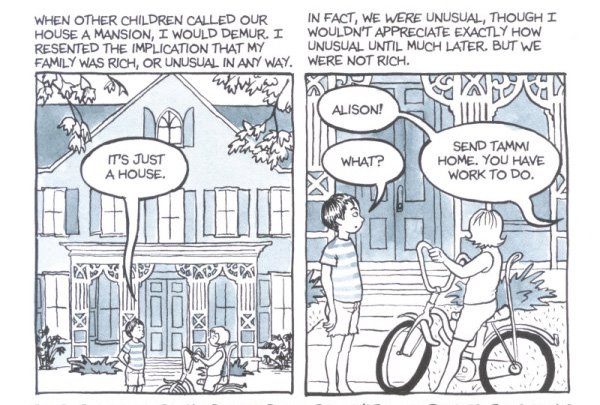
This book is getting reviewed everywhere. It's a comic book memoir; Bechdel (author of Dykes to Watch Out For, a popular comic) writes of the death of her father and coming to terms with her own sexuality and that of her father (a semi-closeted, though married, gay man). The art is wonderful and very well integrated with the text. I failed to fully engage with the story, but I admire the effort and the willingness to be so open with such a private story.

Friday, June 02, 2006

May 2006 Book Reviews

This month: no books on mental illness. Actually, no, wait, there's a memoir about obsessive compulsive disorder. There's also one biography, 1 work of non-fiction, and a book published before 1970.

1. Devil in the Details, Jennifer Traig, Rating: 3.9
The aforementioned memoir about obsessive compulsiveness, Jennifer Traig, a currently functioning and fairly normal adult, writes about growing up with "scrupulousity," an odd manifestation of the disease that manifests itself in extreme religious behavoir(s). Traig, who also writes very clever young adult craft books, is quite funny. The book repeats itself and occasionally loses focus, but is overall fairly satisfying.
2. My Invented Country, Isabel Allende, Rating: 4.1
Do you have any interest in Chile? Plans to go there? Then definitely check this book out. This is a bit of a history of the country, but a very personal one--it's all about what Chile means and is for Allende. It's really quite interesting. You'll learn a lot about Allende along the way, too.
3. Beyond Black, Hilary Mantel, Rating: 2.8
Apparently Mantel is a fairly big deal in contemporary literary circles--this is the first book of hers that I've read, but her name shows up on a lot of lists. Honestly, I didn't like it all that much. It's odd, decently written, and just way too long. To quote the NYTBR, "Beyond Black is a fine work, and from a lesser novelist would have seemed a masterpiece. It is too long -- Muriel Spark would have managed the same effect in a hundred or so crisp pages."
4. Suttree, Cormac McCarthy, Rating: 3.6
Like most McCarthy novels, Suttree is intense, unique, and takes a bit of effort to get into the rhythm of the prose. There's certainly nothing wrong with this book, but I find his westerns much more compelling.
5. The Prime of Miss Jean Brodie, Muriel Spark, Rating: 3.4
Speaking of Muriel Spark, I've finally read one of her books! I can't say that I found it a transformative experience, but Brodie certainly is a memorable character. She's a certain "type" that I'm sure has had great influence on other characters in books and film.
6. Mountains Beyond Mountains, Tracy Kidder, Rating: 3.9
I ran across a review of this title in a magazine recently, which said something to the effect that reading this book would make you a better person. A bold statement, right? Kidder writes about Dr. Paul Farmer, a surreal human being out to save the world. Farmer is an interesting mix of micro- and macro-manager: he founded a foundation that implements revolutionary programs for fighting tuberculosis around the globe; individually treats patients in Haiti; teaches and cares for patients in Boston; writes prolifically; and occasionally manages to spend time with his wife and child. I don't know if I'm really a better person now (honestly, reading about Farmer's life made me feel tired), but I really admire the man. This is a good read. As a sidenote, I really enjoyed learning about one of the secondary characters. Roald Dahl's daughter Ophelia was a long time girlfriend of Farmer and is currently director of the charitable foundation.
7. The Lost Painting, Jonathan Harr, Rating: 4.2
I didn't realize until listening to the author at the end (I listened to the audio version) that this is a work of non-fiction. It reads like a novel--compelling, well-paced, a little romance, a little mystery. Harr writes about the rediscovery of a painting by Caravaggio, and tells the story of the artist's life along the way. It's fun.
8. In Lucia's Eyes, Arthur Japin, Rating: 1.8
All I can say about this is that I was glad when it was over. Really boring.